The Complete Guide to Medicaid Claim Denial Reduction

September 18, 2026

Medicaid claim denials drain revenue and create hours of rework for home care agencies. Every rejected claim means delayed reimbursement, additional staff time on appeals, and cash flow problems that affect your ability to deliver care.


For agencies billing Medicaid, private pay, and long-term care payers, denial prevention starts with understanding where errors originate and stopping them before claims go out the door.


This guide walks you through the root causes of Medicaid claim denials, the specific workflows that prevent them, and how integrated billing and payroll automation reduces rejection rates. You will learn how to connect scheduling, EVV, and payroll into a single denial-prevention workflow that protects your revenue.


Key Takeaways: Medicaid Claim Denial Reduction for Home Care


  • Most Medicaid claim denials in home care stem from preventable documentation, authorization, and coding errors.
  • Pre-bill audits that verify EVV data, authorization limits, and service codes catch errors before submission.
  • Integrated billing and payroll workflows eliminate the data gaps that cause mismatched or incomplete claims.
  • eCaring connects visit verification, billing, and payroll into one flow so agencies reduce denials at the source.
  • Tracking denial patterns by root cause helps your team fix systemic issues instead of reworking individual claims.

What Causes Medicaid Claim Denials in Home Care?


Medicaid claim denials happen when the information on a submitted claim does not match what the payor expects to see. In home care, the most common triggers are missing EVV data, expired or incorrect authorization details, and mismatched procedure codes.


A 2026 study published in Health Affairs Scholar found that Medicaid managed care had the highest initial denial rate for professional claims at 15.1%, compared to 10.5% for Medicare Advantage and 7.8% for commercial payers. For safety-net organizations, initial denial rates were even higher at 13.6% versus 9.2% for other facilities.


These numbers make one thing clear: Medicaid claims require more attention to detail than other payor types. Missing a single required field or submitting outside an authorization window can trigger an automatic denial.


Documentation Gaps and Missing EVV Records

When a caregiver forgets to clock in through the EVV system, or when GPS data fails to capture, the visit record is incomplete. Payors reject claims where visit time, location, or caregiver identity cannot be verified electronically.


Your EVV process needs to capture who delivered the care, when the visit started and ended, where the caregiver was located, and what services were performed. If any of these fields are missing, the claim is likely to be flagged.


Authorization Overruns and Expired Service Plans

Every Medicaid-funded visit ties back to an authorization that specifies the number of approved hours, the date range, and the service type. When your team bills for hours that exceed the authorization or submits claims after the authorization has expired, the payor denies the claim.


Tracking authorization balances manually across dozens or hundreds of clients creates room for error. By the time billing discovers the overrun, the service has already been delivered and the revenue may not be recoverable.


Coding Errors and Payor-Specific Requirements

Each Medicaid program and managed care organization has its own set of procedure codes, modifiers, and taxonomy requirements. Submitting a claim with an incorrect code or missing modifier results in a denial that your billing team must research, correct, and resubmit.


These payor-specific rules change frequently. Agencies that rely on manual lookups or outdated reference sheets face a higher risk of coding-related denials.


How Billing Automation Reduces Medicaid Claim Denials


Billing automation addresses denials at their root by connecting visit data, authorization records, and payor rules into a single workflow. Instead of assembling claim information from multiple sources, your billing team reviews claims that are already built from verified data.


The key shift is from reactive correction to proactive prevention. Automated pre-bill checks identify missing fields, authorization conflicts, and coding mismatches before the claim leaves your system.


Pre-Bill Validation and Error Detection

Automated pre-bill validation compares each claim against the payor's requirements before submission. This includes checking that EVV records are complete, that billed hours fall inside the authorization window, and that procedure codes match the service delivered.


When a claim fails validation, your system flags it for review instead of sending it to the payor. Your billing team fixes the issue once, before submission, rather than appealing a denial weeks later.


How Verified Visit Data Prevents Claim Rejections

Visit verification is the first line of defense against denials. When each shift is verified for time accuracy, location compliance, task completion, and caregiver identity before it enters the billing queue, the data behind each claim is already clean.


eCaring's Auto Shift Verification applies configurable rules to every visit. The Verification Rules Engine evaluates time variances, task completion, signatures, and geofence compliance.


Visits that pass all rules are automatically verified and locked. Exceptions route to a reviewer. By the time a visit reaches billing, its data has already been validated.


Connecting Authorization Tracking to Billing

When your billing platform is connected to your authorization records, the system can flag visits that exceed approved hours or fall outside authorized date ranges before a claim is generated. This prevents authorization-related denials from ever reaching the payor.


eCaring ties each shift to the client's authorization, service type, and payor. Before billing, the platform confirms that visits align with authorizations, units, and utilization. If a visit does not meet payor or EVV requirements, it is flagged for attention rather than submitted.


Why Integrated Payroll Workflows Reduce Denials


Payroll and billing rely on the same underlying visit data. When these workflows run on separate systems, discrepancies between billed hours and paid hours create audit flags and payor inquiries that can result in claim reversals.


Integrated payroll workflows ensure that the hours your agency bills to Medicaid match the hours paid to caregivers. This alignment eliminates a common source of post-payment audits and retroactive denials.


How Payroll and Billing Alignment Prevents Audit Flags

Payors compare billed hours against other data points during audits. If your payroll records show a caregiver was paid for four hours, but your Medicaid claim reflects six hours of service, that discrepancy triggers a review.


When billing and payroll draw from the same verified visit data, these mismatches disappear. The hours billed are the hours paid, because both originate from the same source of truth.


Eliminating Manual Reconciliation Between Systems

Agencies that run billing and payroll on separate platforms spend significant time reconciling data at each cycle. Staff members compare spreadsheets, chase down missing visit records, and correct discrepancies one at a time. Each manual step introduces error risk.


A single platform that handles visit verification, billing, and payroll removes the reconciliation step entirely. eCaring captures verified visit hours, mileage, travel time, PTO, custom pay rates, and pay differentials, then flows all of it into both billing and payroll files from one verified dataset.


Step-by-Step: Building a Denial Prevention Workflow


Reducing Medicaid claim denials requires a structured process that catches errors at each stage of the care-to-claim cycle. The following steps outline how to build a denial prevention workflow for your agency.


Step 1: Capture Complete Visit Data at the Point of Care

Every denial prevention workflow starts with accurate visit records. Your caregivers need a reliable way to document clock-in and clock-out times, GPS location, tasks completed, and client signatures during each visit.


The eCaring Mobile App captures all necessary visit details for EVV compliance. Caregiver locations, clock-in and clock-out times, and attendance records are automatically documented. GPS tracking confirms that caregivers are on-site, and offline mode ensures data capture even in areas with limited connectivity.


Step 2: Apply Verification Rules Before Claims Are Built

Once visit data is captured, your verification rules should evaluate it against agency-defined thresholds. This includes checking time variances between scheduled and actual hours, confirming geofence compliance, and verifying that required documentation is complete.


Visits that meet all rules move forward as verified. Visits with exceptions route to a reviewer for correction before they enter the billing queue. This step prevents unverified or incomplete visit data from becoming a claim.


Step 3: Validate Claims Against Payor Requirements

Before submitting each claim, validate that the procedure codes, modifiers, authorization details, and billed units align with the specific payor's requirements. Different Medicaid programs, managed care organizations, and private payors each have distinct rules.


eCaring's Payor Management module lets agencies configure procedure codes, qualifiers, taxonomy codes, modifiers, and revenue codes for each service at the payor level. Payor-specific billing rules and rates apply automatically, so your team does not need to look up requirements manually.


Step 4: Submit Clean Claims and Track Results

After validation, submit claims and track their status through the billing cycle. Monitor which claims are accepted on first submission and which come back denied. Record the denial reason for each rejected claim.


Over time, this data reveals patterns. You may discover that a specific payor rejects claims with a particular modifier, or that a certain service type has a higher denial rate due to authorization issues.


Step 5: Analyze Denial Patterns and Fix Root Causes

Review denied claims by root cause category: documentation gaps, authorization overruns, coding errors, timely filing issues, and eligibility problems. Then address the systemic issues that produce the highest volume of denials.

eCaring's reporting tools help agencies track billing performance, identify exception patterns, and drill into specific visits or claims. Custom reports allow you to isolate denial trends by payor, service type, or time period, so your team can target the root causes that cost the most.


How EVV Compliance Connects to Denial Prevention


Electronic Visit Verification is not just a regulatory requirement. It is also the foundation of a clean claim. Every piece of data that EVV captures, including caregiver identity, visit start and end time, location, and services delivered, is data that Medicaid payors require on the claim.


When your EVV system feeds directly into billing, each claim is backed by verified visit records. There is no gap between what was documented in the field and what appears on the claim.


What Medicaid Payors Require from EVV Data

Under the 21st Century Cures Act, states must verify six data points for each Medicaid-funded home care visit: the type of service, the individual receiving the service, the individual delivering the service, the date of service, the start and end time, and the location where the service was delivered.


Claims that cannot demonstrate all six data points risk denial. Your EVV system must capture and store this information in a format that flows directly into your billing records.


How GPS and Geofence Verification Strengthen Claims

GPS-verified clock-in and clock-out data confirms that your caregiver was at the client's location during the reported service period. This eliminates ambiguity around visit location, which is one of the six required EVV data points.


Geofence rules add another layer of accuracy. If a caregiver clocks in outside the defined geofence radius, the visit is flagged for review rather than automatically verified. This prevents questionable location data from reaching a claim.


Managing Multiple Payors Without Increasing Denial Risk


Many home care agencies bill Medicaid, managed care organizations, the VA, private pay clients, and long-term care payers simultaneously. Each payor has different coding requirements, billing frequencies, and documentation standards.


Managing these differences manually, whether through spreadsheets or separate billing processes per payor, increases the chance of submitting a claim with the wrong rules applied.


Configuring Payor-Specific Rules in One Platform

The most reliable way to manage multi-payor billing is to configure each payor's rules once and let your billing system apply them automatically. This includes bill rates with effective dates, scheduling constraints tied to authorizations, rounding rules, and procedure code configurations.


eCaring's platform allows agencies to manage billing frequencies, billing differentials, holiday rates, mileage, and expenses at the payor level. Your team knows which visits are ready for billing, which need attention, and why, all from a single dashboard.


Reducing Errors When Switching Between Payor Types

When billers handle Medicaid, MCO, and private pay claims in the same workflow, cross-contamination errors are common. A Medicaid-specific modifier might accidentally get applied to a private pay invoice, or a managed care rate might override a state Medicaid rate.


Automated payor-specific rule application eliminates this risk. Each visit is tied to a client, service, and payor from the moment it is scheduled. The correct billing rules follow the visit through verification, billing, and payroll export without manual intervention.


Common Denial Scenarios and How to Prevent Each One


Understanding the most frequent denial scenarios in home care helps your team build targeted prevention strategies. Here are the denial types that cost agencies the most revenue and how to address each one.


Denial for Missing or Incomplete EVV Data

This denial occurs when the claim lacks one or more of the six required EVV data points. Prevention requires a mobile EVV solution that captures all required fields at the point of care, with automated reminders for caregivers who forget to clock in or out.


SMS-based clock-in and clock-out reminders reduce missed punches. For caregivers in areas without reliable cell service, telephony-based EVV offers a backup that still captures required data.


Denial for Exceeding Authorized Hours

This denial happens when billed hours exceed the client's approved authorization. Prevention requires real-time authorization tracking that alerts schedulers and billers when utilization approaches the approved limit.


Connecting your scheduling module to authorization balances ensures that shifts are not scheduled beyond the approved hours. If a visit would push utilization past the limit, your team can request an authorization extension before the visit occurs.


Denial for Timely Filing Violations

Each payor sets a deadline for claim submission, often 90 to 180 days after the date of service. Claims submitted after this window are denied regardless of accuracy. Prevention requires automated billing workflows that process verified visits on a regular cadence, without allowing claims to age in a manual queue.


How to Measure Your Denial Reduction Progress


Tracking the right metrics helps your agency understand whether denial prevention efforts are working. Focus on these key performance indicators to measure progress.


Clean Claim Rate

Your clean claim rate measures the percentage of claims accepted by payors on the first submission. Agencies with strong denial prevention workflows target a clean claim rate above 95%. If your rate is lower, review the most common rejection reasons and address them in your verification and pre-bill audit processes.


Denial Rate by Root Cause

Break down your total denial rate by category: documentation, authorization, coding, eligibility, and timely filing. This breakdown reveals which area of your workflow needs the most attention. A high authorization denial rate signals a scheduling and utilization tracking problem. A high coding denial rate points to payor configuration issues.


Days in Accounts Receivable

Days in AR measures how long it takes to receive payment after a claim is submitted. High AR days often correlate with high denial rates, because denied claims sit in queues waiting for correction and resubmission. Reducing denials directly shortens your AR cycle and accelerates cash flow.


In Conclusion: Reducing Medicaid Claim Denials Through Connected Workflows


Medicaid claim denial reduction is not about fixing claims after they are rejected. It is about building connected workflows that prevent errors from reaching the payor in the first place. When your EVV, scheduling, verification, billing, and payroll systems operate from a single source of truth, denials drop because the data behind each claim is accurate, complete, and payor-ready.

eCaring brings visit verification, billing, and payroll together in one platform purpose-built for home care agencies. Every billed visit comes backed by EVV data, authorization history, and verified service details, so your claims are clean before they leave your system.


If you are ready to reduce denials and accelerate your billing cycles, book a demo to see how it works for your agency.


FAQs About Medicaid Claim Denial Reduction


What is the most common reason Medicaid home care claims are denied?

Missing or incomplete documentation is the most common reason. Claims that lack required EVV data, expired authorizations, or incorrect procedure codes are flagged for rejection by Medicaid payors.


How does billing automation help reduce Medicaid claim denials?

Billing automation runs pre-submission checks that compare each claim against payor rules, authorization limits, and EVV records. eCaring flags claims that fail validation before submission, so your team fixes errors once rather than appealing denials.


Why does payroll integration matter for claim denial prevention?

Payroll integration ensures that billed hours and paid hours match. eCaring connects billing and payroll to the same verified visit data, eliminating discrepancies that trigger payor audits and retroactive claim reversals.


How can EVV compliance reduce Medicaid claim denials?

EVV captures the six data points Medicaid requires for every home care visit. eCaring's EVV system records caregiver identity, visit times, GPS location, and services delivered, then feeds that verified data directly into billing.


What clean claim rate should home care agencies target?

Agencies with effective denial prevention workflows target a clean claim rate above 95%. Tracking denial reasons by root cause and addressing systemic issues in verification and billing workflows helps agencies reach this target.


How do I track whether my denial prevention efforts are working?

Monitor your clean claim rate, denial rate by root cause, and days in accounts receivable. eCaring's reporting tools let you build custom reports that isolate denial trends by payor, service type, or time period to identify and fix recurring issues.


By Marketing Admin September 18, 2026
Filling a shift is not the same as making a good match. Learn which caregiver and client factors agencies should consider—and how better matching supports continuity of care.
By Marketing Admin September 18, 2026
Medicaid claim denials can delay reimbursement, create hours of administrative work, and make it harder for home care agencies to maintain predictable cash flow. Although a denial appears at the end of the revenue cycle, the underlying problem often begins much earlier. An expired authorization, incorrect service code, missing Electronic Visit Verification record, or undocumented schedule change may not be discovered until after the claim reaches the payer. Preventing denials therefore requires more than correcting claims. Agencies need an operational process that keeps client eligibility, authorizations, schedules, caregiver activity, EVV records, documentation, and billing data aligned. This guide explains ten common causes of Medicaid home care claim denials and the controls agencies can use to prevent them. What Is a Medicaid Claim Denial? A Medicaid claim denial occurs when a claim has been processed and the payer determines that it will not pay the claim or one of its service lines. The Centers for Medicare & Medicaid Services defines a denied fee-for-service claim as one that has completed adjudication but does not meet the payer’s coverage criteria. Examples include missing prior authorization, invalid service codes, an ineligible beneficiary, an invalid provider, or a missed filing deadline. A denial is different from a claim rejection. A rejected claim generally fails an initial submission or data-validation requirement and does not proceed through full adjudication. For example, a file may be rejected because a required identifier is missing or its format does not meet the payer’s specifications. The distinction matters because the appropriate response may be different: A rejected claim usually needs to be corrected and resubmitted. A denied claim may need to be corrected, adjusted, appealed, or supported with additional documentation. Some denials cannot be reversed if the service was not covered or a required deadline was missed. Agencies should always review the payer’s remittance information and reason codes before deciding how to respond. 1. Missing, Expired, or Invalid Authorization Many Medicaid home and community-based services require prior authorization. The authorization may define: The approved service The service period The number of authorized units The billing frequency The approved provider Applicable modifiers or program requirements A claim may be denied when the authorization was not active on the date of service, the billed service does not match the authorization, or the agency did not obtain authorization before providing care. How to prevent it Enter the complete authorization before scheduling services and configure alerts for upcoming expiration dates. Schedulers should only be able to select services that are valid for the client, payer, and authorization period. Agencies should also establish a process for obtaining renewed authorizations before the existing authorization expires. 2. Services Exceed the Authorized Units An authorization can be active while still lacking enough remaining units to cover a visit. This frequently happens when authorization balances are tracked separately from scheduling. A scheduler may create visits based on a client’s normal schedule without realizing that earlier visits, schedule changes, or additional services have consumed the available units. The result may be care delivered beyond the payer’s approved limit. How to prevent it Track scheduled, delivered, billed, and remaining units against the same authorization. The system should warn users before a schedule exceeds the authorized balance—not several weeks later when the billing team prepares a claim. Agencies should pay particular attention to partial authorization periods, changes in service frequency, overlapping authorizations, and units that can be shared across multiple services. 3. The Client Was Not Eligible on the Date of Service Medicaid eligibility can change. A client may lose eligibility, move between plans, enter an institutional setting, change managed care organizations, or experience a temporary coverage gap. A client’s Medicaid identification number alone does not establish that the person was eligible for a specific service on a particular date. How to prevent it Verify eligibility according to the payer’s requirements, especially: When a new client begins services At the start of a new authorization period When the client changes plans When information received from the payer conflicts with the agency’s records Before billing older or previously held visits Document eligibility results and any payer instructions so the billing team can understand what was verified and when. 4. The Claim Uses the Wrong Payer or Program A client may receive services through Medicaid fee-for-service, a managed care organization, a waiver program, an Aging Services Access Point, or another administering entity. If the client changes programs or plans, a claim sent to the previous payer may be denied even though the underlying service was authorized. How to prevent it Maintain effective dates for payer enrollment and program changes. The payer attached to the visit should reflect the client’s coverage on the date of service rather than only the payer currently listed on the client’s profile. When coverage changes retroactively, agencies need a controlled process to identify affected visits, reverse or adjust prior claims when necessary, and rebill the correct payer. 5. Incorrect HCPCS Code, Modifier, or Revenue Code The service described in the care plan, authorization, visit record, and claim must align. A claim can fail when it uses: The wrong HCPCS or procedure code A required modifier that is missing A modifier that is invalid for the service The wrong revenue code A code that was not authorized A code that is no longer effective for the date of service Even a valid code can cause a denial if it does not match the client’s program, provider contract, authorization, or place of service. How to prevent it Configure billing codes at the payer and service level instead of requiring billing staff to select them manually for every claim. Use effective dates so historical visits retain the correct configuration when payer requirements change. Code changes should be reviewed before implementation and tested against the applicable payer’s billing guidance. 6. Missing or Unmatched EVV Data The federal Electronic Visit Verification mandate applies to qualifying Medicaid-funded personal care and home health services that require an in-home visit. An EVV system must electronically verify six categories of information: The type of service performed The individual receiving the service The date of service The location where the service was delivered The individual providing the service The time the service began and ended States and managed care organizations may use EVV data to validate claims. A claim can be delayed or denied when the associated visit is missing, incomplete, rejected by an EVV aggregator, or unable to match the claim. How to prevent it Monitor EVV submissions throughout the billing period instead of waiting until claims are ready. Office staff should be able to identify: Missing clock-ins or clock-outs Invalid client or caregiver identifiers Service-code mismatches Location exceptions Visits rejected by the aggregator Corrected visits that have not been resubmitted Visits that were accepted but do not match the billing record Resolving these issues close to the date of service is usually easier than researching them weeks later. Learn more about how eCaring connects EVV with scheduling and agency operations . 7. Invalid Caregiver or Provider Information A claim or EVV record may be denied when the caregiver, rendering provider, billing provider, or agency identifier is missing, invalid, inactive, or not authorized for the service. Depending on the payer, relevant information might include: National Provider Identifier Medicaid provider identifier Taxonomy code Caregiver or employee identifier Credential or qualification Provider enrollment status Service-specific eligibility A caregiver may also be active within the agency while lacking a credential required for a particular program or service. How to prevent it Connect caregiver compliance records to scheduling. If a credential is required for a service, the scheduling workflow should warn users—or prevent assignment—when that credential is expired or missing. Provider identifiers used for EVV and billing should be centrally maintained, validated, and transmitted consistently. 8. Billed Units Do Not Match the Documented Visit Home care services may be billed by the hour, 15-minute unit, 30-minute unit, event, or another payer-defined methodology. Differences can occur when: Scheduled time is used instead of actual time A caregiver clocks in late or clocks out early Rounding rules are applied incorrectly A visit crosses midnight Breaks are not handled correctly The claim contains more units than the EVV record supports Manual edits change time without updating the related billing record How to prevent it Apply the payer’s unit-conversion and rounding rules consistently. The billing team should be able to trace billed units back to the completed visit, verified time, service configuration, and any approved adjustment. Manual changes to visit time should be permission-controlled and recorded in an audit history. 9. Duplicate or Overlapping Services Duplicate claims can occur when the same service is submitted more than once for the same client and date of service. Common causes include: Resubmitting a claim without identifying it as an adjustment Billing two visits that overlap Generating claims from both an original and corrected visit Combining and separating service lines inconsistently Submitting the same service through two billing workflows Failing to account for another provider’s service Not every same-day service is a duplicate. Multiple visits may be legitimate when they are supported by the authorization, documentation, applicable modifiers, and payer rules. How to prevent it Run duplicate and overlap checks before claim submission. At a minimum, agencies should examine the client, date of service, service code, modifier, caregiver, time range, units, and prior claim history. Corrected claims should remain linked to the original transaction so staff can see whether a claim was replaced, adjusted, voided, or resubmitted. 10. The Claim Missed the Filing Deadline Medicaid agencies and managed care organizations establish timely-filing requirements. These deadlines can vary by payer, program, claim type, and reason for resubmission. An otherwise valid claim may become uncollectible if it is not submitted within the required period. Claims are particularly vulnerable when visits remain unresolved because of missing documentation, EVV exceptions, incomplete authorizations, or payer-enrollment issues. How to prevent it Track unbilled visits by age and reason. Billing teams should have visibility into: Visits approaching the initial filing deadline Rejected claims awaiting correction Denied claims requiring follow-up Claims awaiting documentation Corrected claims that have not been resubmitted Appeals approaching their deadlines Do not rely on a single end-of-month review. High-risk exceptions should be monitored throughout the billing cycle. A Pre-Billing Checklist for Medicaid Home Care Agencies Before submitting a claim, confirm that: The client was eligible on the date of service. The correct payer and program are assigned. An active authorization covers the service and date. Sufficient authorized units remain. The service code and modifiers match the authorization. The caregiver was eligible to provide the service. The visit contains the required documentation. Required EVV data were captured. The EVV record was accepted by the appropriate state or payer system. Billed units match the documented and verified visit. The claim is not a duplicate. The claim is within the timely-filing period. This checklist is most effective when the underlying data are connected. If staff must compare separate scheduling, EVV, authorization, billing, and spreadsheet records, discrepancies are more likely to go unnoticed. Why Connected Operations Matter Many Medicaid billing problems are not created by the billing department. They originate in disconnected workflows. For example: A scheduler creates a visit without seeing the remaining authorization balance. A caregiver completes the visit using an incorrect service. The EVV record is rejected because an identifier does not match. The billing team creates the claim before the rejection is corrected. The payer cannot match the claim to an acceptable EVV record. Payment is denied or delayed. When the same client, payer, service, authorization, caregiver, visit, and EVV information flows through the entire process, agencies can identify problems earlier. That means billing readiness should begin when a visit is scheduled—not when a claim is generated. Read more about how connected operations can reduce Medicaid billing denials . Frequently Asked Questions What is the most common reason Medicaid claims are denied? There is no single denial reason that applies to every Medicaid agency, state, or managed care plan. Common causes include missing prior authorization, inactive eligibility, invalid service codes, provider-enrollment problems, missed filing deadlines, and mismatches between the claim and its supporting EVV or service documentation. The agency’s own remittance data is the best source for identifying its highest-volume and highest-value denial categories. What is the difference between a rejected claim and a denied claim? A rejected claim usually fails an initial submission or data-validation requirement and does not complete adjudication. A denied claim has been adjudicated, but the payer determined that it will not pay all or part of the claim. The payer’s acknowledgment and remittance information should indicate the claim status and the reason corrective action is required. Can a Medicaid claim be denied because of EVV? Yes. State Medicaid programs and managed care organizations may validate qualifying claims against EVV records. A claim may be denied or held when the required EVV record is missing, incomplete, rejected, or does not match the service being billed. The exact claim-matching requirements vary by state, program, and payer. Can a Medicaid denial be corrected and resubmitted? Some denials can be corrected, adjusted, or appealed. The appropriate response depends on the denial reason and payer rules. An agency should not simply submit the same claim again without determining whether the payer requires a corrected claim, replacement claim, adjustment, void, appeal, or supporting documentation. How can a home care agency reduce Medicaid denials? The most effective approach is to prevent inconsistencies before the claim is created. Agencies should connect eligibility, payer enrollment, authorizations, scheduling, caregiver qualifications, EVV, documentation, billing, and remittance data. They should also review denial trends regularly and address the operational causes—not only the individual claims. Build a Cleaner Path From Scheduling to Payment Medicaid billing is the final step in a much larger operational process. When authorizations, schedules, caregiver activity, EVV records, documentation, and claims are managed separately, every handoff creates another opportunity for error. eCaring brings these workflows together in one home care agency-management platform, helping teams identify exceptions earlier and move cleaner information from the schedule through EVV and billing. Explore eCaring’s connected EVV and home care platform , or book a demo to discuss your agency’s Medicaid workflows. This article provides general operational information and is not legal, coding, or reimbursement advice. Medicaid requirements vary by state, program, managed care organization, and provider contract. Agencies should verify requirements with the applicable payer and current program guidance.
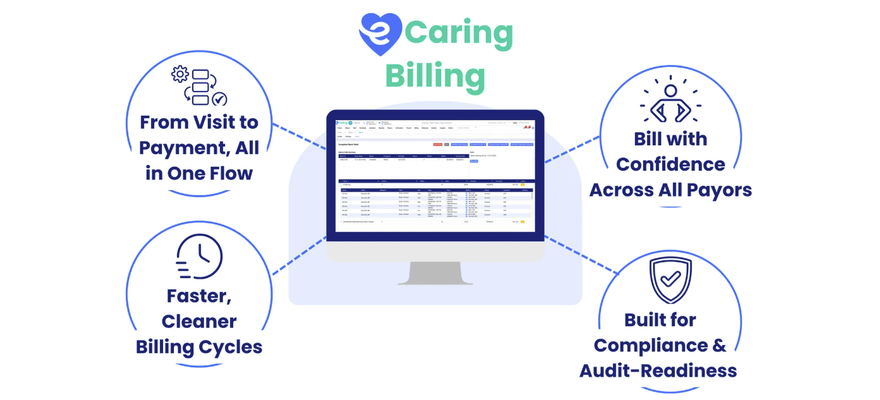
Caring Billing logo with laptop, showing payment workflow, error handling, faster cycles, and compliance for audit readiness
By Marketing Admin September 18, 2026
Billing denials cost home care agencies more than revenue. They consume staff hours, delay cash flow, and create compliance exposure that compounds month over month. For Medicaid providers, the root cause often has nothing to do with the billing department. Denials frequently trace back to upstream breakdowns in scheduling, visit verification, and EVV data capture. This article maps where billing denials originate, how each operational step contributes to claim readiness, and how eCaring connects scheduling, EVV, and billing into one workflow so your agency can submit cleaner claims from the start. Key Takeaways: EVV and Medicaid Billing Most Medicaid billing denials originate upstream in scheduling, EVV, or visit verification rather than in billing itself. Schedule accuracy directly determines whether your claims carry the correct service, authorization, and caregiver data. Connected EVV captures the six data points required by the 21st Century Cures Act within your existing workflow. Rules-based visit verification catches exceptions before claims reach the payor, reducing costly rework and resubmissions. eCaring unifies scheduling, EVV, and billing in a single platform so every visit builds a clean, traceable claim. Why Billing Denials Often Start Before Billing Begins When a Medicaid claim is denied, the billing team typically investigates the rejection code, corrects the data, and resubmits. That cycle consumes hours. According to a 2026 study published in Health Affairs Scholar , Medicaid managed care had the highest initial denial rate for professional claims at 15.1%, with safety-net providers facing even steeper rates. The data error that triggered the denial, however, usually happened days or weeks earlier during scheduling or at the point of care. What Clean Claims Depend On Upstream A clean Medicaid claim requires verified visit hours, confirmed caregiver identity, accurate service codes, valid authorization, and compliant EVV data. Each of those elements originates before billing begins. If the schedule assigns the wrong service type, the claim carries the wrong code. If EVV data is incomplete, the payor rejects the visit. Authorization utilization matters too. When visits exceed authorized units or fall outside approved date ranges, payors deny the claim regardless of how accurately the billing file is formatted. Why Rework Grows in Fragmented Systems Agencies that rely on separate tools for scheduling, EVV, and billing face a reconciliation problem. Data must be exported from one system, reformatted, and imported into another. Each handoff introduces the risk of mismatched records, missing fields, and timing gaps. The billing team ends up manually cross-referencing schedules against EVV logs and authorization records. That manual process does not scale. Errors multiply as visit volume grows. How Scheduling Sets the Foundation for Clean Billing Scheduling is where claim data first takes shape. The service type, caregiver assignment, client authorization, and shift duration all originate in the schedule. If any of those values are incorrect at scheduling time, every downstream system inherits the error. How Schedule Changes Affect Claim Readiness Home care schedules shift constantly. Caregivers call out. Clients cancel. Shifts get reassigned. Each change needs to update the caregiver, service code, and authorization link. In disconnected systems, those updates may reach the billing file late or not at all. eCaring's Smart Scheduling Engine ties every shift to the client's service, payor, and authorization record. When a shift is reassigned, the platform carries forward the correct data. Schedulers see near real-time compatibility scores for every caregiver-client pairing, factoring in availability, location, historical care, and overtime considerations. How Real-Time Visibility Helps Teams Intervene Earlier Late arrivals, missed clock-ins, and no-shows all create billing gaps. If the office learns about a missed visit hours later, the window to correct or reschedule may have closed. eCaring sends automated shift reminders to caregivers via SMS and alerts schedulers to late arrivals in near real-time. Shift Pop gives schedulers shift-level details including scheduled time versus actual duration, shift status, and direct communication tools. That visibility lets teams resolve issues before they become billing problems. How EVV Strengthens Visit Integrity and Compliance The 21st Century Cures Act requires Medicaid-funded personal care and home health visits to capture six data points electronically: the type of service, the client receiving care, the caregiver providing care, the date, the location, and the start and end times. Missing or inaccurate EVV data is one of the most common reasons Medicaid claims are denied or delayed. What EVV Data Needs to Capture Compliant EVV is more than a GPS check-in. Each visit record must tie the caregiver's identity and location to the specific service authorized for that client on that date. The data must align with the schedule and the authorization to pass payor validation. The eCaring Mobile App captures all necessary visit details to comply with EVV regulations. Caregiver locations, clock-in/out times, and attendance records are automatically documented, ensuring full compliance with state requirements. The app also supports offline workflows and synchronizes data when connectivity returns. Why Connected EVV Is Better Than a Disconnected Process When EVV is a standalone system, agencies must export visit data and reconcile it against their scheduling and billing platforms. That reconciliation adds administrative time and introduces discrepancies that trigger denials. eCaring keeps EVV connected to the work your agency is already doing. Every step builds on the same client, caregiver, payor, service, authorization, and care-plan information that started in the schedule. Office staff can review visit activity, identify exceptions, and complete verification from within the same application. How Visit Verification Reduces Exceptions Before Claims Go Out Visit verification is the checkpoint between care delivery and billing. It confirms that what was scheduled, what was delivered, and what will be billed all align. Without a structured verification step, discrepancies pass through to claims and become denials. How Rules-Based Verification Works eCaring's Auto Shift Verification follows a four-step process. First, authorized care is completed and visit details including time, tasks, signatures, and location are recorded. Second, agency-defined rules evaluate time variances, task completion, signatures, and geofence compliance. Third, visits meeting all rules are automatically verified, while exceptions are routed for manual review. Fourth, verified service details are locked and flow into billing and payroll . With configurable rules tailored to each agency's thresholds, visits can be automatically verified or flagged for review with precision and consistency. How Exception Review Reduces Manual Cleanup Not every visit will pass automated verification. A caregiver may clock in outside the geofence, or a shift may run longer than the authorized duration. What matters is whether your team catches those exceptions before billing or after a denial. eCaring routes flagged visits to the appropriate staff for review. Schedulers can manually verify shifts that fall outside auto-verification rules, with real-time editing and a full audit trail . This pre-billing review prevents exceptions from becoming rejected claims. How eCaring Connects Scheduling, EVV, and Billing in One Workflow Unlike traditional platforms where visit verification is fragmented across scheduling, finance, and payroll teams, eCaring brings everything together into a single, intelligent workflow. That connection between modules is what makes clean billing possible at scale. What Billing Teams Can Trace in One System Every billed visit in eCaring comes backed by EVV data covering time, location, and caregiver identity. Each visit record also includes care notes, tasks, shift details, authorization and utilization history, and a log of user actions and adjustments. When a payor, auditor, or internal stakeholder asks for proof, everything is already in the system, linked and traceable. That traceability means billing teams spend less time chasing missing data and more time reviewing claims that are ready to submit. Why Connected Data Supports Faster Payments When all visit, authorization, and payor data is in sync, your billing team can generate claims and billing files tailored to payor requirements, create accurate private pay invoices per client and date range, and reduce manual corrections, rejected claims, and write-offs. eCaring's Payor Management supports Medicaid, MCOs, VA, private pay, and long-term care payors in one place. The platform applies payor-specific rules and rates automatically, ensures visits align with authorizations and utilization, and flags visits that do not meet payor or EVV requirements before billing. The result is shorter billing cycles, healthier cash flow, and less administrative stress. In Conclusion: Cleaner Medicaid Billing Starts with Better Operations Billing denials are a downstream symptom of upstream operational gaps. When scheduling, EVV, and visit verification operate in disconnected systems, errors accumulate and billing teams absorb the cost of reconciliation and rework. Connected operations change that pattern. When every shift is tied to the right client, service, authorization, and payor from the moment it is scheduled, and when EVV and verification happen within the same workflow, your claims carry the data payors need the first time. eCaring was built for this purpose: to give home care agencies a single source of truth from scheduling through billing, reducing the fragmentation that creates denials in the first place. FAQs about Medicaid Billing Denials and EVV What are the most common causes of Medicaid billing denials in home care? The most frequent causes include missing or inaccurate EVV data, mismatched service codes, authorization overages, and incomplete caregiver documentation. These issues typically originate in scheduling or at the point of care, not in the billing department. How does EVV compliance reduce Medicaid claim denials? EVV captures the six data points required by the 21st Century Cures Act, including caregiver identity, location, and visit times. When that data is accurate and connected to your schedule and authorizations, claims pass payor validation with fewer rejections. eCaring captures EVV data within the same workflow your team already uses for scheduling and billing. What is Auto Shift Verification, and how does it prevent billing errors? Auto Shift Verification is eCaring's rules-based process that evaluates each visit against agency-defined thresholds for time variance, task completion, signatures, and geofence compliance. Visits that pass are automatically verified and locked for billing. Exceptions are routed for manual review before claims are generated. Can connected scheduling really improve billing outcomes? Yes. When your schedule is tied to client authorizations, payor rules, and service codes, every shift starts with the data billing needs. eCaring's Smart Scheduling Engine links each shift to the correct client, service, payor, and authorization record, so downstream systems inherit accurate information from the start. How does eCaring help agencies manage multiple Medicaid payors? eCaring's Payor Management module handles Medicaid, MCOs, VA, private pay, and long-term care payors in one platform. The system applies payor-specific rules and rates automatically and flags visits that do not meet requirements before billing, so your team can address issues before claims go out.