Medicaid’s New Payment Reality: EVV Claim Matching, Redeterminations, and Provider Readiness
September 26, 2026
Medicaid programs are connecting EVV, eligibility, provider enrollment, and claims more closely. Learn what providers should do to remain compliant and protect cash flow.
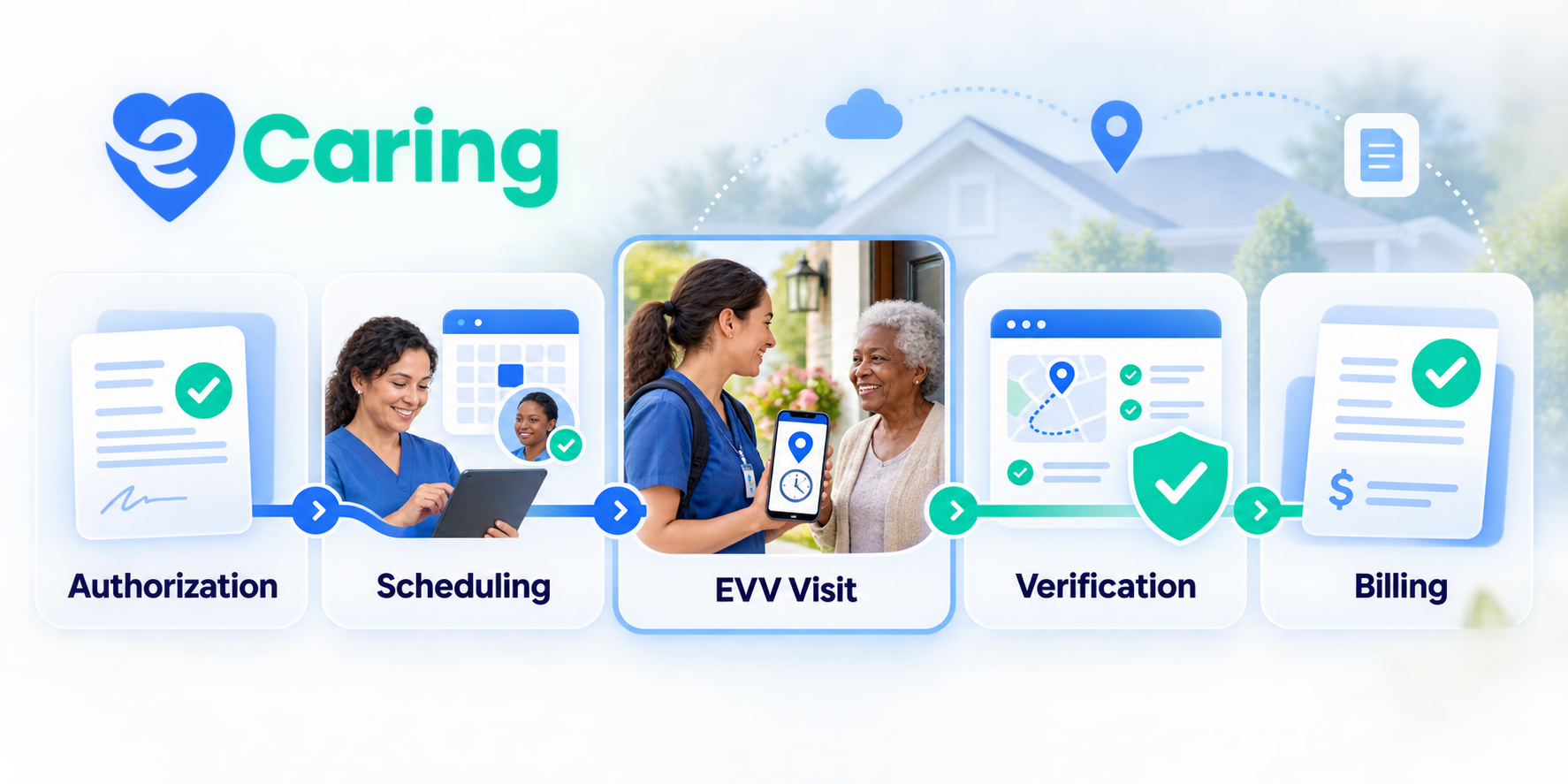
For Medicaid home care providers, Electronic Visit Verification is no longer only a documentation requirement.
Across the country, states are connecting EVV records more directly with Medicaid claims, member eligibility, provider enrollment, authorizations, and program-integrity reviews. A visit may have occurred and been properly documented, but payment can still be delayed or denied if the information submitted through EVV does not match the corresponding claim.
At the same time, new eligibility redetermination requirements and provider revalidation initiatives are increasing the likelihood of changes to member coverage, payer assignments, provider status, and billing responsibility.
The practical lesson for providers is clear:
Scheduling, authorization, eligibility, EVV, billing, and payment can no longer be treated as separate administrative processes.
Providers need a connected operational backbone that keeps the same client, caregiver, service, authorization, visit, payer, and claim information aligned from the moment care is scheduled through final payment.
What Is EVV Claim Matching?
EVV claim matching is the process of comparing a Medicaid claim with the Electronic Visit Verification record supporting the billed service.
The 21st Century Cures Act requires EVV systems for qualifying Medicaid-funded personal care and home health services that require an in-home visit. At a minimum, the EVV record must verify:
- The type of service performed
- The individual receiving the service
- The date of service
- The location where the service was delivered
- The individual providing the service
- The time the service began and ended
States administer EVV differently. Some use a state-selected system, while others allow providers to use an alternate EVV vendor that submits data to a state or managed care aggregator.
Increasingly, states and payers are using that EVV data to validate claims before payment. Depending on the program, the matching process may compare:
- Medicaid member identifier
- Provider or agency identifier
- Caregiver identifier
- Date of service
- Service or procedure code
- Applicable modifiers
- Visit start and end times
- Units billed
- Authorization information
- EVV visit status
- Whether the visit was accepted by the state’s aggregator
If the records do not align, the claim may be rejected, suspended, denied, or selected for additional review.
Why EVV Compliance Is Becoming a Revenue-Cycle Issue
Many agencies initially approached EVV as a caregiver timekeeping requirement: capture the clock-in, capture the clock-out, and submit the visit.
Claim matching changes that model.
A successful clock-in does not necessarily mean the visit is ready to bill. The visit must also contain the correct client, provider, service, date, time, units, and program information—and the state or payer must be able to associate that visit with the claim.
Consider a caregiver who correctly clocks in and out, but the visit is transmitted with the wrong service modifier. The EVV record may exist, and the caregiver may have delivered the authorized care, but the claim can still fail to match.
Similar problems can occur when:
- The client’s Medicaid identifier differs between the EVV and billing records.
- The billing provider identifier does not match the EVV submission.
- The visit remains unverified in the aggregator.
- Corrected visit data was not resubmitted.
- Billed units exceed the time supported by EVV.
- The claim uses a different service code or modifier.
- The visit exceeds the client’s remaining authorization.
- The claim reaches the payer before the EVV record is accepted.
EVV therefore sits directly on the path between service delivery and reimbursement.
Recent State Changes Show Where Medicaid Payment Is Heading
There is no single national EVV claim-matching process. Each state, program, and managed care organization may apply different rules.
However, recent developments illustrate a broader movement toward more direct validation of claims against visit and provider data.
Georgia: EVV Becomes Mandatory for Applicable Home Health Claims
Georgia completed its fee-for-service Home Health Care Services EVV implementation with a mandatory go-live date of September 14, 2026.
According to Georgia Medicaid, applicable home health claims with dates of service on or after September 14 must be submitted through EVV. Georgia also publishes detailed mappings of affected services, procedure codes, modifiers, and billing units.
That level of specificity matters. A provider must do more than capture that a visit occurred. The service and units reported through EVV must align with what is ultimately billed.
For agencies using an alternate EVV vendor, successful transmission to Georgia’s Netsmart system is also an essential part of the workflow. An internally complete visit is not enough if the aggregator rejects it or cannot associate it with the appropriate provider, member, or service.
Review Georgia Medicaid’s EVV requirements.
Missouri: EVV Claims Validation Moves Into Enforcement
Missouri has been implementing EVV claims validation to compare qualifying claims with EVV visit records.
During claims validation, mismatches involving the provider, participant, service, units, or visit status can affect whether a claim is payable. Missing or unverified EVV records can also create payment problems.
Missouri’s transition demonstrates why providers should not wait for a denial to investigate EVV quality. Agencies need to identify unmatched visits and rejected records before the billing file is created.
A provider should be able to answer:
- Has the visit been successfully submitted?
- Was it accepted by the aggregator?
- Does it contain the correct participant identifier?
- Does the provider identifier match the claim?
- Are sufficient verified units available?
- Was a corrected visit transmitted successfully?
- Is the claim ready to be submitted?
When these questions cannot be answered until after adjudication, cash flow becomes dependent on avoidable rework.
Review Missouri’s EVV claims-validation guidance.
Massachusetts: Hard Edits Raise the Importance of Pre-Bill Validation
Massachusetts has been preparing fee-for-service providers for EVV hard edits across affected home health, Group Adult Foster Care, Adult Foster Care, and certain waiver programs.
Under a hard-edit model, an EVV mismatch is not merely an informational warning. It can prevent payment until the underlying issue is resolved.
Massachusetts guidance illustrates the operational complexity involved in matching:
- Member information
- Billing and servicing provider identifiers
- Service codes
- Dates of service
- Units
- Accepted EVV visits
- Special visit scenarios such as overnight services
Providers cannot assume that a visit is billable simply because it appears complete in their agency-management system. They must also know whether the corresponding record has been accepted by Sandata and whether it contains the information required to support the claim.
Review the Massachusetts EVV hard-edits guidance.
Ohio: EVV Data Becomes Part of Broader Program-Integrity Enforcement
Effective October 6, 2026, Ohio law requires the Department of Medicaid to establish additional verification requirements for in-home care providers classified as high risk.
The criteria used to identify high-risk providers must include:
- Repeated mismatches in check-in data
- Impossible travel times
- Claims overlapping with a Medicaid recipient’s hospital stay when services were not delivered according to an authorized plan
- Unusual billing outliers
- Other indicators of potential fraud
High-risk providers may be required to use additional identity-verification methods as a condition of payment.
This does not mean every Ohio provider is automatically subject to enhanced verification. It does show, however, that EVV, claims, travel, hospital, and billing data are increasingly being analyzed together.
Providers need accurate records and an auditable history of what was scheduled, what occurred, what was changed, who made the change, and what was submitted.
Read Ohio Revised Code Section 5164.421.
Eligibility Redeterminations Add Another Layer of Payment Risk
EVV claim matching is only one part of the changing Medicaid environment.
Beginning with renewals scheduled on or after January 1, 2027, states must generally conduct eligibility renewals every six months for most individuals enrolled in the Medicaid adult expansion group. Previously, the applicable federal renewal cycle was generally 12 months.
The new six-month requirement does not apply to every Medicaid beneficiary or every HCBS population. CMS identifies specific affected populations and exemptions, while non-MAGI eligibility groups generally remain on at least an annual renewal cycle.
Even with that qualification, more frequent renewals may result in more eligibility and payer changes that affect provider billing.
For a home care agency, a redetermination can lead to:
- Continued eligibility under the same program
- Movement to a different eligibility group
- A change between fee-for-service and managed care
- A new managed care organization
- A change in covered services
- A new or revised authorization
- Temporary loss of coverage
- Termination of eligibility
- Retroactive updates that affect previously scheduled services
A valid EVV record cannot overcome a lack of eligibility or authorization. If the client was not eligible for the billed program on the date of service, the claim may still be denied.
Review CMS guidance on the 2027 eligibility-redetermination changes.
Provider Revalidation Can Also Interrupt Payment
Member eligibility is not the only status providers must monitor.
Medicaid agencies periodically require providers to revalidate their enrollment. Missing a provider revalidation deadline can result in the closure of a service location or loss of billing eligibility.
For example, Pennsylvania announced an off-cycle revalidation initiative requiring affected high-risk providers to revalidate by December 31, 2026. Providers who fail to complete revalidation by the deadline specified in their notice may have the affected service location closed in the state’s PROMISe system.
Agencies should distinguish:
- Member eligibility redetermination
- Provider enrollment revalidation
- Service authorization renewal
- Caregiver credential renewal
Each can affect whether a properly delivered visit ultimately produces a payable claim.
Review Pennsylvania’s provider-revalidation bulletin.
The Operational Chain Behind Every Payable Visit
A payable Medicaid home care visit depends on multiple records remaining aligned.
A simplified workflow looks like this:
- The client is eligible for the applicable Medicaid program.
- The agency and service location are actively enrolled.
- The payer or managed care plan is correctly identified.
- A valid authorization covers the service and date.
- The correct service, code, modifier, and unit methodology are configured.
- A qualified caregiver is assigned.
- The caregiver captures the required EVV information.
- When there are no exceptions, eCaring automatically verifies the visit.
- If exceptions exist, eCaring makes it clear what those exceptions are so your office staff can confidently resolve exceptions and verify the visit.
- The EVV record is accepted by the appropriate state or payer system.
- The claim matches the supporting authorization and EVV data.
- The payer adjudicates the claim.
- The agency reconciles the payment, denial, or adjustment.
A disconnect at any point can interrupt payment.
That is why EVV claim matching cannot be solved by the billing department alone. The source of a denial may originate days or weeks earlier in intake, authorization entry, scheduling, caregiver assignment, visit capture, verification, or aggregator submission.
A Pre-Billing Readiness Checklist
Before billing an EVV-required visit, providers should confirm:
- The client was eligible on the date of service.
- The correct payer and program are assigned.
- The provider and service location remain actively enrolled.
- An active authorization covers the service.
- Sufficient authorized units remain.
- The service code and modifiers are correct.
- The assigned caregiver was qualified to provide the service.
- All required EVV data were captured.
- The visit was reviewed and verified when required.
- Any manual edits are supported and auditable.
- The EVV submission was accepted by the state or payer system.
- Corrections were successfully resubmitted.
- The billed units are supported by the verified visit.
- The claim will use the same identifying information as the EVV record.
- The claim is within the payer’s timely-filing period.
This review should happen before claim submission—not after a denial appears on the remittance advice.
Why a Connected Platform Matters
Many providers use separate tools for scheduling, EVV, authorizations, billing, payroll, compliance, and reporting.
Each additional system introduces another handoff:
- Client data may be entered differently.
- Service codes may be mapped inconsistently.
- Authorization balances may not update when schedules change.
- Corrected visits may not reach the billing system.
- Billing staff may not see aggregator rejections.
- Schedulers may not know that a client’s eligibility or payer changed.
- Payroll may rely on different time data than billing.
Spreadsheets and manual reconciliation can temporarily bridge these gaps, but they become increasingly difficult to manage as claim-matching requirements grow.
A connected platform creates a common operational record from schedule through payment.
How eCaring Supports Medicaid Providers
eCaring connects the information providers need to manage Medicaid-funded care:
- Client and Medicaid program information
- Payers and services
- Authorizations and unit balances
- Care plans and visit tasks
- Caregiver qualifications and assignments
- Recurring and one-time schedules
- Point-of-care EVV capture
- Visit verification and exception management
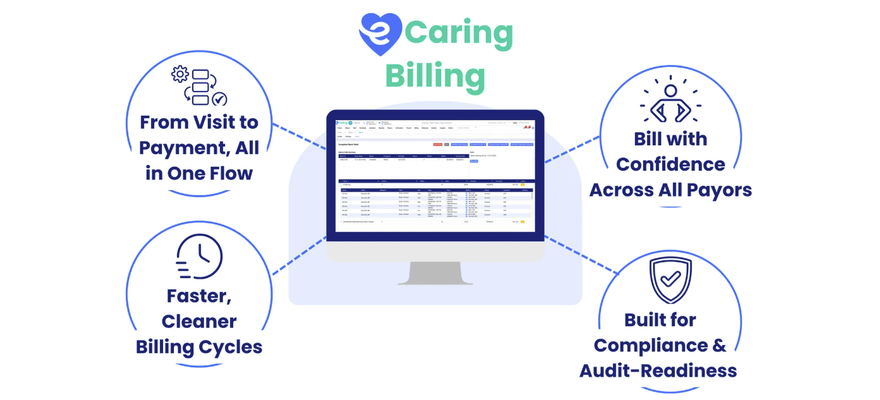
- Billing and claim generation
- Payment posting and reconciliation
- Reporting and audit history
The workflow begins with information already used to manage the client and schedule the visit. Caregivers capture visit activity through eCaring Staff v2, including workflows that can continue when connectivity is unavailable and synchronize eligible information when service returns.
Office teams can review visit activity, identify incomplete or rejected records, correct eligible errors, and monitor submission results. eCaring supports connections with EVV aggregators including Sandata, HHAeXchange, Tellus/Netsmart, and AuthentiCare, depending on the applicable state and program.
That connectivity helps agencies identify issues before they become claim denials.
For example, the office can investigate when:
- A caregiver missed a clock-in or clock-out.
- A visit contains an EVV exception.
- An aggregator rejected the submission.
- Client or caregiver identifiers do not match.
- The scheduled service differs from the submitted visit.
- A correction has not been accepted.
- Units may exceed the applicable authorization.
- A visit is not ready to proceed to billing.
eCaring does not replace an agency’s responsibility to understand state, payer, and program requirements. No software can guarantee that every claim will be paid.
What a connected platform can do is give providers greater visibility, consistent data, actionable exceptions, and an auditable workflow for correcting problems before billing.
Frequently Asked Questions
Does every Medicaid claim require an EVV match?
No. EVV applies to qualifying Medicaid-funded personal care and home health services that require an in-home visit. Specific services, codes, programs, and claim-matching rules vary by state and payer.
Providers should consult current guidance from the applicable state Medicaid agency, managed care organization, and EVV aggregator.
Can a claim be denied when an EVV visit exists?
Yes. The claim may still fail if the EVV record is incomplete, unverified, rejected, or does not match the claim’s client, provider, service, date, units, or other required information.
Does an accepted EVV visit guarantee claim payment?
No. EVV acceptance is only one part of claim readiness. Eligibility, provider enrollment, authorization, coverage, coding, documentation, timely filing, and other payer rules may still affect payment.
How do Medicaid redeterminations affect home care providers?
A redetermination can change a client’s eligibility, program, managed care plan, covered services, or authorization. Providers should verify current eligibility and payer information and should not assume that an existing schedule or prior authorization remains billable after a coverage change.
What is the difference between redetermination and revalidation?
Redetermination usually refers to reviewing a Medicaid beneficiary’s eligibility. Revalidation refers to reviewing a provider’s enrollment.
Both can affect payment: a client must be eligible for the service, and the provider must remain properly enrolled to bill for it.
What should providers do before EVV claim matching begins?
Providers should validate client and provider identifiers, confirm service-code mappings, review authorization balances, resolve EVV exceptions promptly, monitor aggregator responses, test corrections, train office and field staff, and establish a pre-billing reconciliation process.
Compliance and Payment Now Depend on the Same Connected Data
The direction of Medicaid administration is unmistakable.
States are using EVV, eligibility, provider, authorization, claims, and program-integrity data together. As these connections become tighter, providers have less room for disconnected records, delayed corrections, and manual reconciliation.
The agencies best positioned to adapt will be those that can see the entire operational chain—from the authorized service and scheduled visit to the accepted EVV record, clean claim, and final payment.
eCaring provides the connected backbone home care agencies need to manage that chain, respond to changing state requirements, and resolve exceptions before they disrupt reimbursement.
Learn how eCaring connects scheduling, EVV, and state submission workflows.
This article provides general operational information and is not legal, coding, or reimbursement advice. Medicaid, EVV, eligibility, enrollment, and claim-matching requirements vary by state, program, payer, service, and provider type. Providers should verify current requirements with the applicable Medicaid agency, managed care organization, and EVV administrator.